
OpenVPN's hub-and-spoke architecture forces all traffic through central gateway servers, introducing latency penalties, single points of failure, and infrastructure overhead that scales poorly for distributed teams. Organizations managing remote workforces discover that gateway dependencies create the bottlenecks they're trying to solve.
This roundup evaluates five alternatives addressing OpenVPN's limitations, from mesh networking eliminating gateways entirely to Zero Trust platforms providing application-level access control. Whether you need architectural modernization or operational simplification, these solutions offer practical paths beyond traditional VPN constraints.
1. NetBird
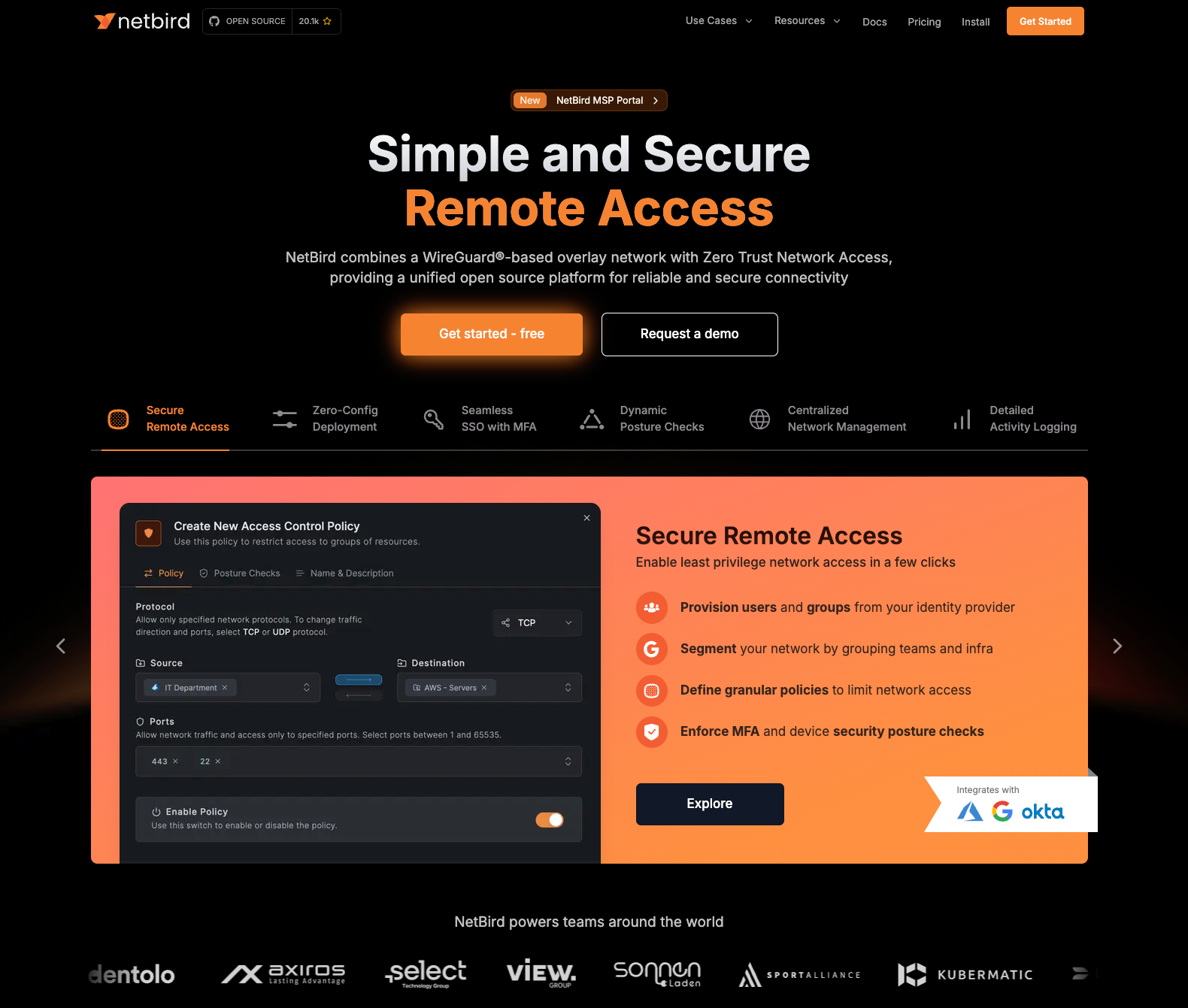
For organizations trapped in OpenVPN's outdated client-server architecture, NetBird represents a fundamental topology shift: direct peer-to-peer mesh networking that eliminates gateway bottlenecks entirely. Built on WireGuard and licensed under BSD 3-Clause (client) and AGPLv3 (server), NetBird replaces OpenVPN's certificate-heavy, manually configured gateway model with automated mesh connectivity managed through SSO integration and visual dashboards.
Why choose NetBird over OpenVPN?
NetBird eliminates the central gateway architecture that defines OpenVPN Access Server, replacing hub-and-spoke routing with direct peer-to-peer connections between endpoints. Where OpenVPN forces all traffic through gateway servers, creating latency penalties and single points of failure, NetBird establishes encrypted WireGuard tunnels directly between devices based on access policy. A developer in Singapore connecting to Tokyo infrastructure routes directly peer-to-peer, not through a Virginia gateway, simply because that's where the VPN server lives.
NetBird's distinguishing capabilities for OpenVPN migrations:
- Automated P2P Mesh Architecture: Establishes direct encrypted connections between devices without routing traffic through central servers, eliminating OpenVPN's gateway bottlenecks and latency overhead across geographically distributed teams.
- Modern WireGuard Protocol: Uses WireGuard implementation delivering line-speed throughput with minimal CPU overhead, which is substantially faster than OpenVPN's SSL/TLS processing that bottlenecks under high-bandwidth workloads.
- Control Center Topology Visualization: Provides interactive network topology graphs showing real-time peer relationships, group memberships, and connection status, therefore addressing OpenVPN's operational blind spot where administrators troubleshoot through SSH sessions and log files.
- SSO-Based Authentication: Connects directly with organizational identity providers for centralized authentication, eliminating OpenVPN's manual certificate lifecycle management and enabling policy-based access tied to actual user identities.
- Identity-Aware SSH Access: Grants shell access based on SSO credentials and policy conditions, replacing traditional SSH key distribution with IdP integration; a capability OpenVPN cannot replicate without external tooling.
- Commercial Self-Hosting Experience: Delivers full-featured management dashboard, unlimited connections, and SSO integration in self-hosted deployments, without the constraints of OpenVPN Community Edition (CLI-only) or Access Server's 2-connection free tier limit.
However, NetBird's mesh model requires organizations to adopt granular access policies where connectivity depends on group membership and device posture. The platform's smaller ecosystem also means fewer third-party integrations compared to OpenVPN's mature tooling landscape.
Is NetBird free for commercial use?
Yes, NetBird's free tier supports up to 5 users and 100 devices with complete P2P encryption, basic SSO integration, and access controls. The Team plan ($5/user/month) includes unlimited devices, MFA, audit logging, and IdP user provisioning. The Business plan ($12/user/month) adds posture checks, EDR integrations, and dedicated support.
Quick Verdict: Best for organizations escaping OpenVPN's hub-and-spoke architecture while maintaining enterprise management capabilities. Ideal for distributed teams, multi-cloud environments, and companies requiring Zero Trust access with SSO integration and visual management tools. Not suitable for scenarios requiring OpenVPN protocol compatibility or organizations dependent on OpenVPN-specific tooling integrations.
2. Twingate
Twingate shifts from OpenVPN's network-level connectivity to application-level access control through Zero Trust Network Access architecture. Rather than granting subnet access via encrypted tunnels, Twingate connects users to specific resources through lightweight Connectors deployed behind firewalls.
Why choose Twingate over OpenVPN?
Twingate replaces network-level connectivity with application-specific access control, eliminating the security gap where OpenVPN grants subnet access and relies on secondary controls for resource authorization. OpenVPN provides network connectivity: once authenticated, clients reach any resource on connected network segments, requiring internal firewalls and complex routing policies for segmentation. Twingate inverts this model by making application-level access the primitive, granting permissions to specific services rather than entire networks.
Twingate's differentiating capabilities include:
- Application-Level Access Control: Grants permissions to specific applications and services rather than network subnets, enforcing least-privilege by design instead of relying on post-connection firewalls.
- Connector Architecture: Deploys lightweight outbound-only agents behind firewalls to broker access without exposing resources to the internet or requiring inbound port opening, simplifying firewall configuration compared to OpenVPN's publicly accessible gateway requirements.
- Split Tunneling by Default: Routes only authorized application traffic through Twingate, leaving general internet traffic on local connections; avoiding OpenVPN's performance degradation from routing all traffic through VPN or the complexity of split-tunnel configuration.
- Native Device Posture Checks: Validates endpoint security status, including OS patch level and disk encryption, before granting access (Teams plan), with EDR integration capabilities for CrowdStrike and SentinelOne in the Business tier, Zero Trust controls that OpenVPN cannot enforce without third-party NAC solutions.
Twingate's application-centric model eliminates broadcast domains and restricts lateral movement capabilities. However, while ICMP and CIDR-based routing are supported, applications expecting service discovery protocols (mDNS, NetBIOS) or unrestricted subnet-wide connectivity will require architectural adjustment. Moreover, Twingate’s Controller operates as a SaaS-only solution (Connectors and clients run on your infrastructure), unlike OpenVPN's fully self-hosted model.
Is Twingate free for commercial use?
Yes, Twingate's Starter tier is free for up to 5 users with core functionality, including split tunneling and conditional access controls. The Teams plan ($5/user/month billed annually, $6/month billed monthly, up to 100 users) adds SSO integration, MFA enforcement, native device posture checks, and SaaS application gating. The Business plan ($10/user/month billed annually, $12/month billed monthly, up to 500 users) includes automated user provisioning via IdP, EDR integrations, and enhanced logging. Enterprise pricing provides custom account sizes and SLAs.
Quick Verdict: Best for organizations prioritizing application-level access control and Zero Trust principles over traditional network connectivity. Ideal for distributed environments requiring least-privilege enforcement and granular audit trails. Not suitable for scenarios requiring broadcast domain functionality, legacy applications expecting service discovery protocols, or organizations needing fully self-hosted infrastructure control beyond Connector deployment.
3. SoftEther VPN

SoftEther VPN is an open source, multi-protocol VPN server released under the Apache License 2.0 that accepts connections from OpenVPN, L2TP/IPsec, MS-SSTP, and SoftEther clients on a single server instance. Originating as a Japanese university research project focused on VPN performance optimization, SoftEther functions as a protocol translator enabling gradual migration strategies without forcing simultaneous client upgrades across thousands of endpoints.
Why choose SoftEther over OpenVPN?
SoftEther eliminates OpenVPN's protocol lock-in by implementing compatibility with standard OpenVPN clients while simultaneously supporting other VPN protocols, therefore enabling infrastructure upgrades independent of client rollout timelines. Organizations can transition gateway servers to SoftEther during maintenance windows while legacy endpoints continue functioning unchanged, addressing the practical challenge where forcing simultaneous upgrades across global operations creates unacceptable disruption risk.
SoftEther's core capabilities for specific use cases include:
- Native Layer 2 Bridging: Designed as a virtual Ethernet switch where remote clients appear on the same broadcast domain as local resources, enabling industrial protocols and legacy applications requiring layer-2 visibility. Unlike OpenVPN's TAP mode (a legacy feature the project is deprecating), SoftEther implements bridging as a core architectural primitive.
- Multi-Protocol Server: Accepts OpenVPN, L2TP/IPsec, MS-SSTP, and SoftEther clients on a single instance, eliminating infrastructure duplication when supporting diverse client types across industrial equipment, legacy devices, and standard endpoints.
- VPN-over-HTTPS Port 443: Encapsulates VPN traffic within standard HTTPS connections, traversing restrictive firewalls and bypassing deep packet inspection systems; critical for users in censored networks or corporate environments blocking VPN protocols.
- VPN-over-DNS and ICMP: Supports tunneling over DNS queries and ICMP packets for extreme censorship bypass scenarios where all other protocols are blocked; a capability modern ZTNA platforms cannot replicate.
- OpenVPN Protocol Compatibility: Functions as a drop-in replacement for OpenVPN servers without client reconfiguration, though at OpenVPN performance levels rather than SoftEther's optimized throughput.
However, SoftEther's configuration complexity follows a U-curve: significantly easier initial setup than OpenVPN (Day 1), but complexity spikes above OpenVPN once requiring high-performance customization, automation, or debugging (Day 100).
Is SoftEther free for commercial use?
Yes, SoftEther VPN operates under Apache License 2.0 with no usage restrictions, user limits, or feature gates. Organizations can deploy unlimited servers and support unlimited concurrent connections without licensing costs. Like OpenVPN, the software is free, but organizations pay for server infrastructure, bandwidth, and the expertise required to design and maintain deployments.
Quick Verdict: Best for industrial environments that require Layer 2 protocols (PLCs, SCADA, BACnet), censorship bypass scenarios needing VPN-over-DNS/ICMP capabilities, and legacy device integration where native L2TP/IPsec support is essential. Ideal for organizations needing multi-protocol gateway consolidation. Not suitable for standard remote access, where modern mesh networking (NetBird) or Zero Trust platforms (Twingate) provide better security, performance, and operational simplicity.
4. Cisco Secure Client
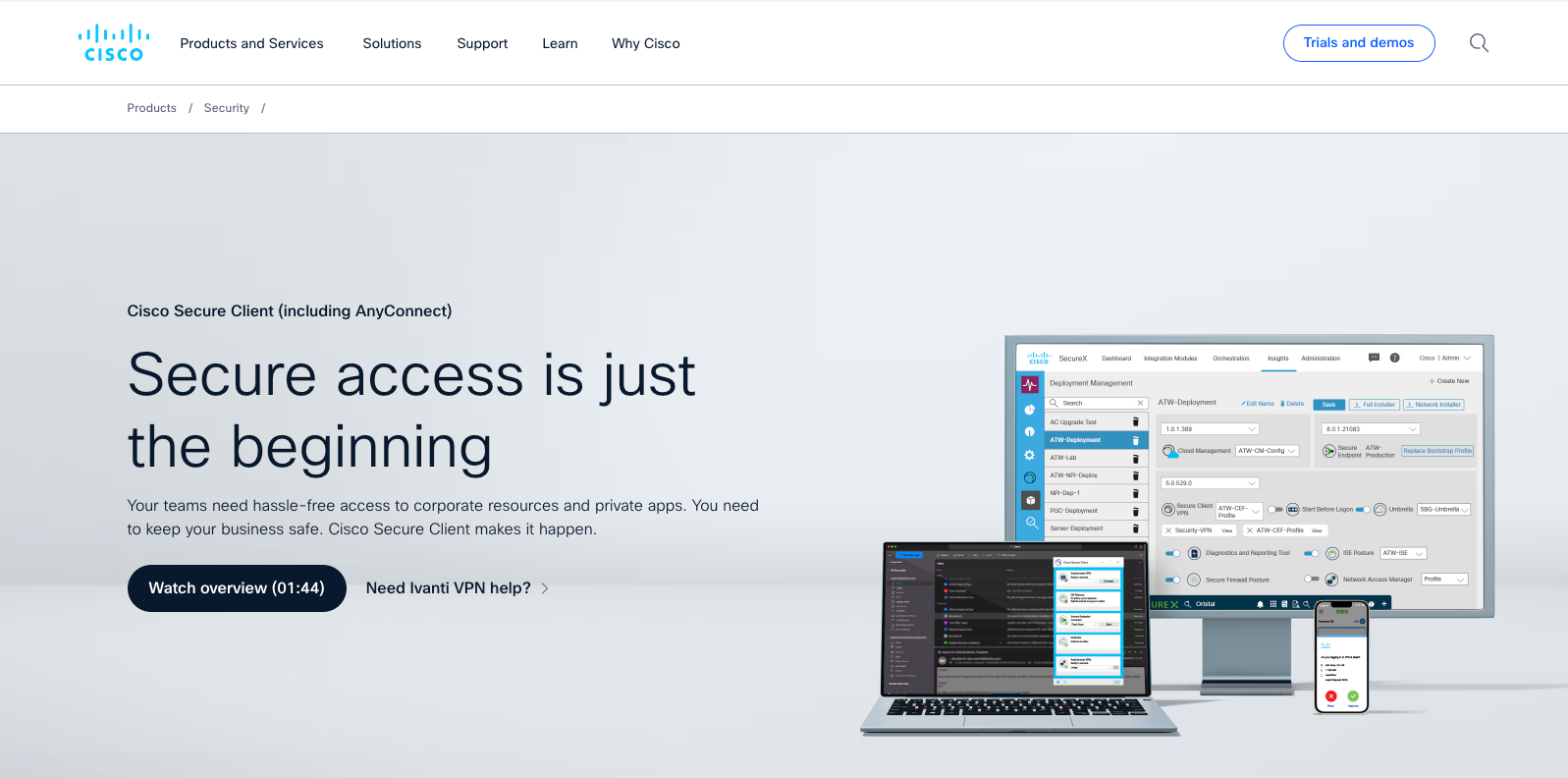
Cisco Secure Client (formerly AnyConnect) delivers VPN connectivity as one component within Cisco's comprehensive security ecosystem, integrating with ASA firewalls, Firepower threat defense, ISE identity services, and Umbrella DNS security. Unlike standalone VPN solutions, Cisco Secure Client achieves enterprise capabilities through deep coupling with Cisco infrastructure, which is valuable for organizations already standardized on Cisco platforms, but restrictive for those seeking vendor-neutral architectures.
Why choose Cisco Secure Client over OpenVPN?
Cisco Secure Client eliminates OpenVPN's integration burden by providing unified policy management across VPN, firewall, endpoint security, and identity systems through Cisco's security portfolio. OpenVPN establishes encrypted tunnels but remains largely separate from endpoint posture verification, threat detection, and centralized identity policy. Organizations bridge these gaps through custom integration projects connecting OpenVPN to RADIUS servers, MDM platforms, and SIEM systems.
With Cisco Secure Client, teams can benefit from:
- Unified Security Architecture: Integrates VPN connectivity with firewall policy, intrusion prevention, and malware protection on shared Cisco hardware platforms, eliminating operational complexity of connecting OpenVPN to separate security appliances through custom integration.
- Cisco Identity Services Engine Integration: Ties VPN authentication to a centralized identity policy engine, enabling dynamic access control based on user role, device posture, and network context; capabilities OpenVPN achieves only through external RADIUS and custom scripting.
- AnyConnect Network Access Manager: Provides enterprise Wi-Fi and wired 802.1X authentication through the same client software, consolidating network access methods under unified policy without separate supplicant applications.
- Cisco Umbrella DNS Security: Extends DNS-layer security to VPN clients, blocking malicious domains and phishing sites before connections are established, protection that OpenVPN deployments achieve only through separate DNS filtering services.
- Hardware-Accelerated Throughput: Offloads cryptographic operations to dedicated encryption accelerators (QuickAssist) on ASA and Firepower platforms, maintaining line-speed performance under high concurrent connection loads where OpenVPN on general-purpose servers becomes CPU-bound.
Keep in mind that Cisco Secure Client is intended to operate within its ecosystem; integrating non-Cisco components introduces friction, fragmenting the unified architecture it claims to eliminate.
Is Cisco Secure Client free for commercial use?
No, Cisco Secure Client requires licensing through Cisco's security appliance portfolio with non-transparent pricing dependent on deployment architecture, user counts, and feature tiers.
Organizations must engage Cisco sales or authorized partners for quotes. Pricing complexity reflects integration with Cisco hardware platforms and ecosystem services, fundamentally different from OpenVPN's transparent infrastructure cost model.
Quick Verdict: Best for large enterprises with existing Cisco security infrastructure seeking unified policy management across VPN, firewall, endpoint, and identity systems. Ideal for organizations where security architecture standardization and vendor-supported platforms outweigh flexibility concerns.
5. Pritunl
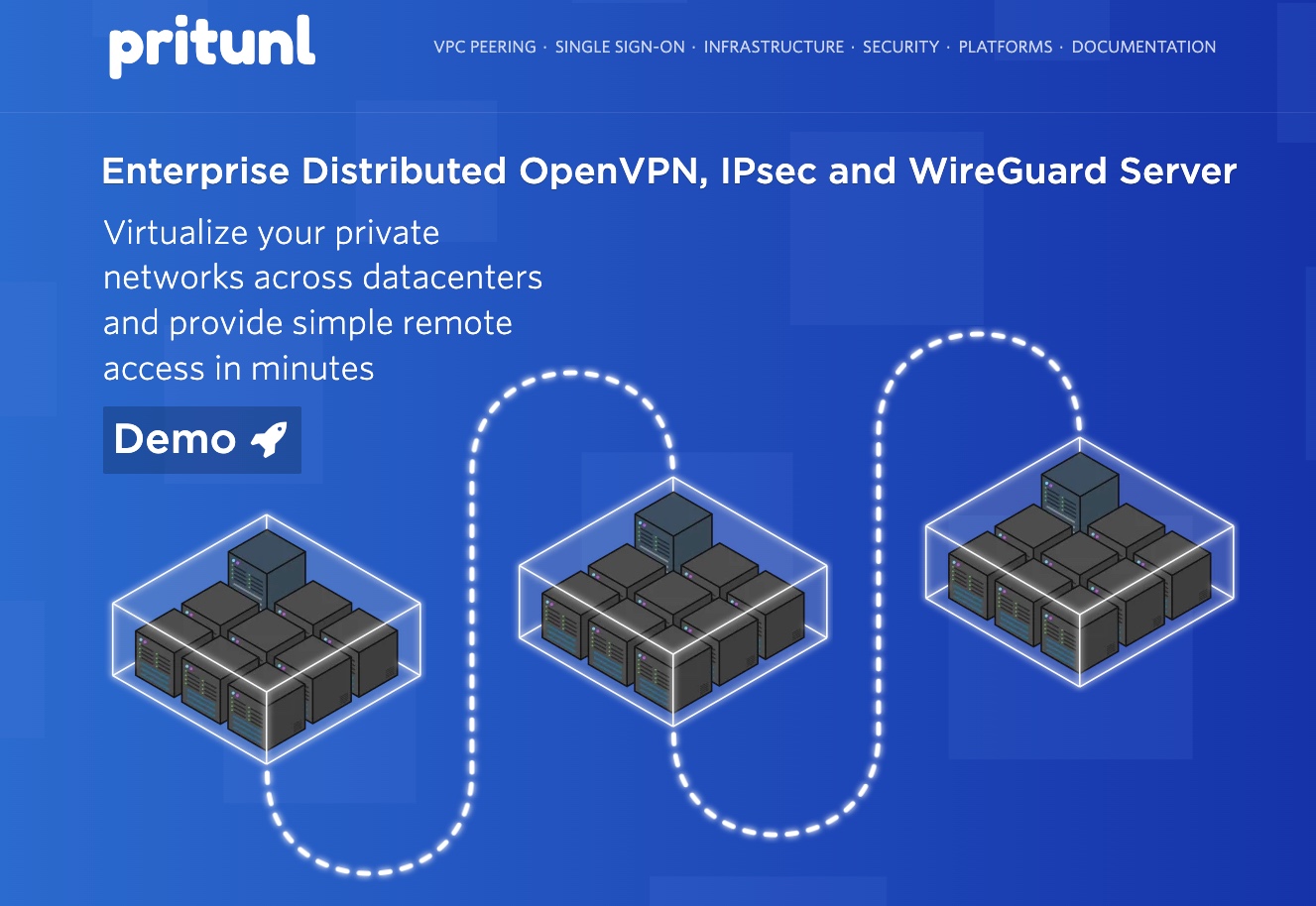
Pritunl transforms OpenVPN from command-line tools and configuration files into a web-administered platform supporting multiple VPN protocols. Released under a permissive open source license, Pritunl preserves OpenVPN's gateway architecture while eliminating the certificate generation scripts, routing table edits, and manual client config distribution that make OpenVPN operationally burdensome, addressing the management complexity without requiring architectural transformation.
Why choose Pritunl over OpenVPN?
Pritunl eliminates OpenVPN's operational complexity through web-based administration while maintaining the familiar gateway architecture. Organizations maintaining OpenVPN deployments accumulate shell scripts for certificate generation, Python tools for user provisioning, and documentation explaining server configs, client configs, and routing relationships. Pritunl replaces this operational debt with standardized workflows: adding users, rotating certificates, and configuring routing through interfaces designed for these specific tasks rather than text file editing.
Here are Pritunl's key operational improvements over OpenVPN:
- Web-Based Administration: Provides graphical management for all VPN operations, eliminating OpenVPN's requirement for SSH access and manual configuration file editing, enabling delegation to team members without Linux expertise.
- Multi-Protocol Gateway Support: Supports OpenVPN and WireGuard for remote user connections, with IPsec for site-to-site links, though all protocols terminate at central gateways (not P2P mesh).
- MongoDB-Based Clustering: Stores configuration and user data in MongoDB databases, enabling server clustering and cross-site replication; operational capabilities that OpenVPN's file-based configuration cannot provide, though requiring additional database infrastructure.
- Automated Certificate Management: Handles certificate authority creation, host certificate generation, and renewal through the administrative interface, eliminating error-prone shell scripts and openssl commands.
- Self-Service User Portal: Provides an interface where users download client configurations and view connection history without administrator intervention, reducing help desk load compared to OpenVPN's manual config distribution.
- Route Management Interface: Simplifies network routing configuration through graphical tools, addressing OpenVPN's challenge where incorrect directives create connectivity issues requiring packet capture analysis.
Despite its many benefits, Pritunl preserves OpenVPN's gateway architecture with inherent limitations: central gateways remain traffic bottlenecks and single points of failure. MongoDB dependency adds infrastructure complexity compared to file-based OpenVPN configurations. SSO integration requires the Enterprise tier ($70/host/month), creating cost barriers for small teams expecting SSO in lower tiers.
Is Pritunl free for commercial use?
Yes, Pritunl's free tier supports single-server deployments with unlimited users and devices, suitable for small organizations or single-site operations. The Premium tier ($10/host/month) enables multi-server deployments with clustering, port forwarding, and gateway links. The Enterprise tier ($70/host/month) adds SSO integration, automatic failover, and AWS VPC peering for high availability and cloud integration.
Host-based pricing scales with server count rather than user population, potentially advantaging large user bases on limited infrastructure. Organizations requiring SSO integration face significant cost increases even with small deployments, as this capability requires Enterprise tier pricing.
Quick Verdict: Best for organizations looking to maintain OpenVPN's gateway architecture while eliminating operational complexity through web-based administration. Ideal for IT teams managing VPN infrastructure without dedicated network engineering resources or requiring OpenVPN/WireGuard remote access with site-to-site IPsec connectivity. Not suitable for teams seeking mesh networking architectures, Zero Trust access control models, or small organizations requiring SSO without Enterprise-tier costs.
Which OpenVPN alternative should you choose?
NetBird and Twingate represent architectural departures from gateway VPN models; NetBird eliminates central servers through P2P mesh; Twingate replaces network connectivity with application-level access control. Organizations frustrated with gateway bottlenecks, complex routing, or broad network access should evaluate these, recognizing they require rethinking network security rather than replacing software.
SoftEther and Pritunl preserve gateway architecture while addressing operational pain points. SoftEther provides multi-protocol flexibility for industrial Layer 2 requirements, censorship bypass, and legacy device support. Pritunl wraps OpenVPN in web-based administration, eliminating operational complexity without architectural change. Teams satisfied with gateway topology but exhausted by administrative burden will find these immediately practical.
Cisco Secure Client modernizes OpenVPN through comprehensive Cisco ecosystem integration. This benefits enterprises already invested in Cisco infrastructure, but creates vendor dependency that open source alternatives explicitly avoid.
The strategic choice: are you solving OpenVPN's operational complexity or its architectural limitations? Pritunl addresses operations. NetBird and Twingate solve architecture. SoftEther handles niche protocol requirements. Cisco provides enterprise unification at the cost of vendor lock-in.
Technical Specifications Comparison
| Platform | Open Source | Self-Hosting | Cloud Option | Key Differentiator |
|---|---|---|---|---|
| NetBird | BSD 3-Clause (client) + AGPLv3 (server) | Yes, core features (cloud-exclusive: IdP sync, SIEM) | Yes (SaaS) | P2P mesh eliminating gateways + Control Center visualization + Identity-Aware SSH |
| Twingate | No (proprietary) | Connectors only (Controller SaaS) | Yes (SaaS) | Application-level access control via Connector architecture |
| SoftEther VPN | Yes (Apache 2.0) | Yes, full features | No | Layer 2 bridging + multi-protocol + VPN-over-DNS/ICMP for censorship bypass |
| Cisco Secure Client | No (proprietary) | Requires Cisco hardware | Yes (managed) | Unified security architecture with Cisco XDR/ISE/Umbrella integration |
| Pritunl | Yes (permissive) | Yes, full features | No | Web-based OpenVPN/WireGuard management with MongoDB clustering |
Strategic Fit Analysis
| Platform | Ideal Use Case | Notable Limits |
|---|---|---|
| NetBird | Distributed teams requiring mesh networking, organizations eliminating gateway bottlenecks, cloud-native infrastructure | Per-user pricing scales with team size; self-hosted lacks some cloud features; smaller ecosystem |
| Twingate | Security teams enforcing application-level access, multi-cloud environments, compliance requiring granular audit trails | No full network layer access; incompatible with subnet-dependent workflows; SaaS-only Controller |
| SoftEther VPN | Industrial Layer 2 protocols (SCADA, PLCs), censorship bypass via DNS/ICMP tunneling, legacy L2TP/IPsec device integration | Configuration complexity (U-curve: easy Day 1, hard Day 100); ~80% OpenVPN spec coverage; gateway architecture limitations |
| Cisco Secure Client | Large enterprises with Cisco infrastructure, unified security policy management, vendor support requirements | Comprehensive vendor lock-in; opaque pricing requiring sales engagement; requires Cisco hardware; Enterprise-tier complexity |
| Pritunl | IT teams seeking OpenVPN operational simplification, gateway architecture satisfaction, multi-protocol remote access needs | Gateway topology performance constraints; SSO requires Enterprise tier ($70/host); MongoDB infrastructure dependency |
Key Takeaways:
- Best for architectural modernization: NetBird (P2P mesh) or Twingate (application-centric ZTNA)
- Best for operational simplification: NetBird (modern policy-driven) or Pritunl (gateway UI management)
- Best for specialized protocols: SoftEther (Layer 2 bridging, censorship bypass, legacy device support)
- Best for enterprise ecosystems: Cisco Secure Client (unified Cisco security platform integration)
- Best for gradual migration: NetBird or SoftEther (run alongside existing infrastructure without disruption)
Choose based on what you're optimizing for: escaping gateway architecture entirely (NetBird, Twingate), managing gateways better (Pritunl, SoftEther), or integrating with existing enterprise infrastructure (Cisco). All platforms deliver secure connectivity; the differentiation lies in architectural philosophy and operational model.